
An army jawan was killed and two of his colleagues were injured when militants triggered an IED explosion targeting a patrol team along the LoC in Akhnoor area of Jammu district, a senior army official said on Monday.

'The potential of one such LAC engagement going out of control and leading to heavy casualties cannot be ruled out,' warns Lieutenant General Syed Ata Hasnain (retd).

This is the second such incident of mutilation of the body of an Indian soldier on the LoC since October 29.
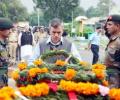
Jammu and Kashmir Chief Minister Omar Abdullah on Friday reviewed the functioning of security grid at a high level meeting in winter capital Jammu following the twin militant attacks on Thursday that left four army personnel including a lieutenant colonel, four cops and two civilians dead.

Under the India-China agreement on the disengagement process in eastern Ladakh, the Chinese army will pull back its troops to east of Finger 8 areas in the northern bank of Pangong lake, Defence Minister Rajnath Singh said in Parliament on Thursday, in what is seen as a significant step to dial down tensions in the key face-off site.

Scotland Yard's War Crimes Team, which is part of its Counter-Terrorism Command, has launched an investigation into the role of British mercenaries in fighting the Liberation Tigers of Tamil Eelam (LTTE) rebels in Sri Lanka during the 1980s.

'There are major implications for India. Though there was a transparently thin attempt to project the troop reduction as intended to promote peace, the downsizing is actually part of plans to streamline and strengthen the PLA, capable of defending China's national interests at home and abroad,' says Jayadev Ranade.
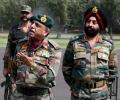
There are more questions than answers about the Indian Army's Keran operation, says R S Chauhan. Was the infiltration bid not detected because the army had vacated two old observation posts, he asks. Why did the infiltrators decide to stay put and fight once they were detected? Were the infiltrators Pakistani Special Forces?

Pakistan perceives that if it had declared Gilgit-Baltistan, PoK or both, which are only a part of the territories of J&K, as legitimate provinces of Pakistan it would weaken its case for the entire J&K and lead to legal complications, observes Lieutenant General Syed Ata Hasnain (retd).

Brigadier M P Bajwa (retd), commander of the troops that captured Tiger Hill, tells Rediff.com's Archana Masih how a band of young soldiers won the Kargil War's most famous battle with their blood and grit.

Seeking to strengthen mutual trust between their armed forces, India and China are planning to hold exercises between their navies and air forces also in the near future.

There is no conceivable reason for any big power to put road blocks on the path of an India-Pakistan normalisation process, asserts Ambassador M K Bhadrakumar.

A US RC-135S reconnaissance aircraft on Wednesday flew near the ongoing Chinese People's Liberation Army (PLA) drills in the South China Sea, a day after another US spy plane, a U-2, trespassed into another PLA exercise restricted zone, state-run Global Times reported.

'If one puts the context of what Xi Jinping said at the UN about not wanting a 'hot or cold war with any country', one realises that his speech was quite bizarre.' 'The world does not expect such statements from China, a nation aspiring to be a superpower.

The Indian Army on Monday celebrated the Infantry Day, marking the landing of first batch of troops in Kashmir 67 years back to push back Pakistani troops, with Prime Minister Narendra Modi paying tributes to the martyrs who dedicated their lives to protect unity of the country.

The IMD has also issued a red-coded warning alert to the Odisha and West Bengal coasts.

Here's a glimpse of all that happened around the world last month, in 20 images.

As per the agreement reached by the two sides, India and China will withdraw the forward deployment in a phased and coordinated manner, the defence minister said.

'The government is doing away with crucial laws such as the Forest Conservation Act and the Environment Protection Act which had helped safeguard our forests.' 'The President has to show that she will stand in favour of tribal rights.'

With flood waters receding, the armed forces have stepped up its rescue operations in Jammu and Kashmir
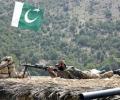
Violating the ceasefire, Pakistani Rangers on Sunday opened fire at Tawi area in R S Pura sector of Jammu district.

The death toll is Jammu and Kashmir mounts to nearly 200 and thousands still wait to be evacuated.
We do not know, because there has been no discussion, no transparency and most likely no real thinking on this matter at our end, observes Aakar Patel.

The sortie had to be executed in good weather and in sub-zero temperatures, which meant it was to be accomplished by mid or third week in May before the earth heated up and the monsoon clouds made things difficult.
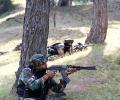
'If the strength of foreign terrorists can be brought to negligible levels there will be few takers for militancy.' 'That is why it is important to neutralise the terrorists at their launch pads,' advises Lieutenant General Syed Ata Hasnain (retd).
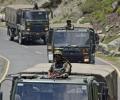
'The one aspect which no Indian military thinker would wish to see emerge is a LoC type of posture at the LAC.' 'The LoC is manned for 750 km and terrorist infiltration has led to the creation of a virtual fortress along its entire length.' 'Something mirroring this at the LAC is going to be expensive although deployment everywhere is not warranted there.' 'However, given the complete trust deficit, there appear few alternatives,' notes Lieutenant General Syed Ata Hasnain (retd).
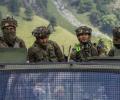
'The leverage created by the Indian military must not be lost.'
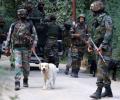
'What has changed is the desperation of Pakistan proxies and the separatists in their failure to foment violence and civilian casualties in Kashmir.'

A range of retaliatory measures are being weighed by India's generals.

Claude Arpi salutes Lieutenant General Zorawar Chand Bakshi, India's most decorated general, who passed into the ages recently.

It is not known whether the BSF personnel was killed by the terrorists or had fallen victim to 'friendly fire'.

A controversy has erupted over the portrayal of the Jat king of Bharatpur in the movie.

On August 6 and August 9 of 1945, warfare changed forever when the United States dropped two atomic bombs on Japan, devastating the cities of Hiroshima and Nagasaki and killing more than 100,000 people. The attack on the people of Hiroshima at 8:15 a.m. on August 6, 1945, and the second attack on the city of Nagasaki at 11:02 am on August 9 killed and wounded hundreds of thousands of unsuspecting men, women, and children in a horrible blast of fire and radiation, followed by deadly fallout. In years that followed, those who survived -- the hibakusha -- suffered from the trauma of the experience and from the long-term effects of their exposure to radiation from the weapons. Before the blast, they were thriving cities. In a flash, they became desolate wastelands. Seventy-five years later, take a glimpse at the destruction.

A war hero looks back at the men and the moments that forged India's greatest military victory.
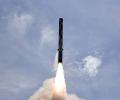
In any conflict with China, the unmanned BrahMos could be advantageously used in the opening stages for pinpoint strikes on heavily defended targets -- such as air bases, headquarters, key roads and railways or logistics dumps -- which are too dangerous for manned fighter aircraft to attack.

'War is won by team work. War is won by sacrifices,' says Subedar Sanjay Kumar, Param Vir Chakra.

India was fooled into believing that Communist China wanted a 'negotiated' settlement with the Tibetans; it was never the case, says Claude Arpi.

'The standing committee on defence was flagging what the services had said.' 'As a soldier, General Khanduri might have felt that it was his duty to point this out in the greater good of India,' points out Aditi Phadnis.

Their leaders in the provinces, which have been under the control of Taliban commanders for several months now, speak the language of the bigot. Women are known to have been abducted and enslaved. Several young girls have simply disappeared.

Access to Sabang Port will allow the Indian Navy to dominate Malacca Strait more effectively, reports Ajai Shukla.
